

Advanced practice nursing has solutions to urgent health challenges: we cannot let it stall
Direct from the International Council of Nurses (ICN) 14th Nurse Practitioner/Advanced Practice Nurse Network (NP/APN) Conference, Nashville, Tennessee

In yesterday’s NP/APN Network conference keynote address, ICN CEO Howard Catton laid out the compelling evidence for advanced practice nursing and warned that letting it stall now would be one of global health’s greatest missed opportunities.
Addressing APN leaders at the world’s largest global advanced practice nursing gathering of its kind, Mr Catton called on governments and health-system leaders to move beyond recognition of advanced practice nursing and take the concrete policy decisions needed to expand it.
Drawing on global workforce data, international policy developments, and a growing body of evidence on safety, effectiveness and economic value, Mr Catton made a forceful case that advanced practice nursing is one of global health’s most powerful and proven solutions. He told attendees:
“All the data shows that APN is a proven solution to the defining challenges facing our health systems and is one of the most powerful ways to prevent illness, manage conditions, and keep people well. Here in the US and across the world, advanced practice nurses are making an extraordinary impact, expanding access to care for underserved populations, managing increasingly complex health needs and chronic health conditions, and leading the move to preventive primary care and safe, effective, people-centred services. In short, advanced practice nurses offer exactly what health systems urgently need: expert care, close to communities, improving access, value, and health outcomes. At a time of severe workforce shortages, rising noncommunicable diseases, stalled progress on global health goals and intense economic pressure, failing to enable the power of advanced practice would be indefensible. We have the evidence and we have the expertise. What we need now is the political commitment, investment and regulation to turn advanced practice nursing from a missed opportunity into a global health priority.”
Today is World Patient Safety Day, marked on 17 September under the theme “Safe care for noncommunicable diseases”, and Mr Catton added:
“As we mark World Patient Safety Day this week, the evidence is clear: advanced practice nursing is a safe and effective solution for people living with NCDs, helping them manage their conditions, preventing deterioration and avoiding unnecessary hospital admissions.”
An evidence-based answer to escalating need
Mr Catton highlighted the stark global context. Around half of the world’s population still lacks access to essential health services, while health systems face severe nursing and medical workforce shortages; expanding health needs from ageing populations, chronic diseases, multimorbidity, and mental health challenges; and rising humanitarian needs and crises. According to the World Health Organization, without urgent action, the world is off track to achieve every single health-related Sustainable Development Goal (SDG) target by 2030. Together, these pressures demand a new approach to delivering care, one that shifts services closer to communities, strengthens prevention and primary health care, and enables every health professional to contribute at the full level of their education and expertise.
Leading the preventive, primary, person-centred care shift
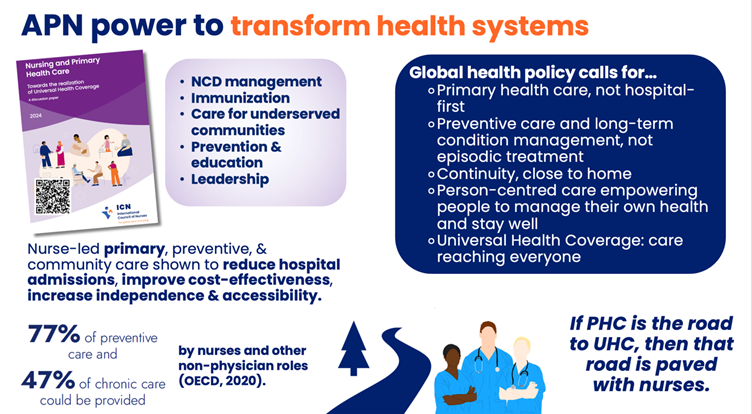
Advanced practice nurses are at the heart of this transformation. Their advanced clinical expertise enables them to assess, diagnose, manage and coordinate care, while their nursing foundations keep that care grounded in prevention, trusted relationships and the holistic realities of patients’ lives, including the social determinants of health.
Mr Catton presented strong evidence, including major Cochrane reviews, showing that advanced practice nurses provide safe and effective nurse-led care, with strong health outcomes and patient satisfaction. He also drew on international examples showing how advanced practice nurses bring services closer to communities, improve access for underserved populations and provide continuity for people living with multiple long-term conditions. Their work helps health systems move beyond episodic treatment towards integrated, preventive and genuinely people-centred care.
Advanced practice nursing is also critical to crisis preparedness and response.
Mr Catton stressed that countries cannot wait for the next emergency before building this capacity. Investing now in advanced practice education, leadership and crisis preparedness equips nurses to maintain essential services, protect communities and lead health-system recovery when crises strike. Through its #NursesforPeace initiative, ICN continues to support nurses in conflict and crisis zones to respond to emergencies, sustain health systems, support communities and help to build the foundations for recovery and peace.
From policy recognition to decisive action
Mr Catton co-chaired the Steering Committee of the landmark World Health Organization State of the World’s Nursing 2025 report and drew on its findings to demonstrate both the progress that has been achieved and what still needs to be done.
He celebrated the report’s finding that 62% of participating countries have established advanced practice nursing roles, up from 53% in 2020, with a further 13% reporting partially established roles. However, he warned, nursing capability remains uneven. There are profound differences in the number and distribution of nurses available in lower- and higher-income countries, while inconsistencies in education, recognition, regulation and scope of practice continue to prevent many advanced practice nurses from using their full capabilities.
SOWN and the WHO Global Strategic Directions for Nursing and Midwifery recognize advanced nursing as essential to the reorientation of health systems towards primary health care, particularly for disadvantaged communities.
Turning these global policy commitments into decisive action requires more than creating advanced roles on paper, Mr Catton said. Countries must educate, attract and retain advanced practice nurses, create sustainable career pathways and ensure that their expertise is not restricted by outdated regulation or lost through burnout, understaffing and poor working conditions.
He concluded:
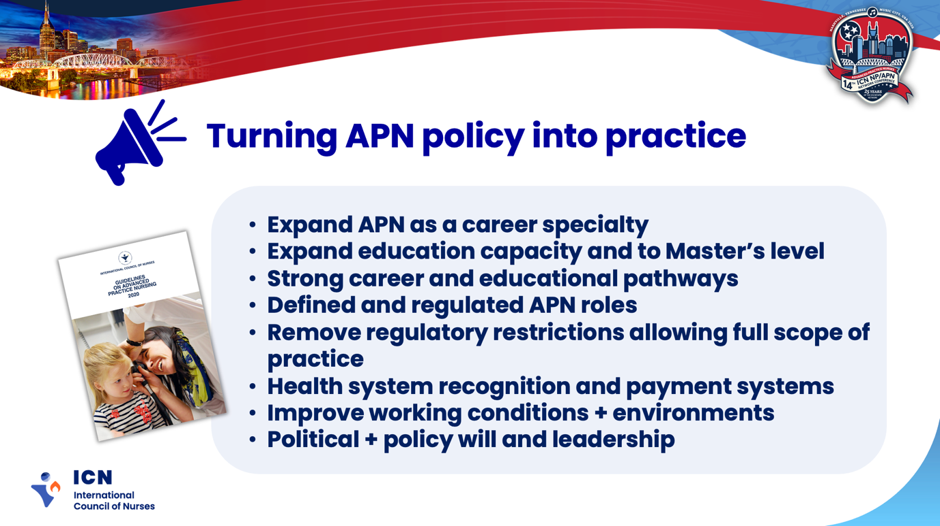
“Health systems cannot rely on advanced practice nurses to lead transformation while failing to provide the conditions they need to stay, thrive and lead. It is time for leaders to:
- invest in high-quality, accessible advanced practice education;
- regulate clearly and consistently;
- protect advanced practice titles and define roles clearly;
- enable advanced practice nurses to work to their full scope;
- create sustainable jobs, career pathways and leadership opportunities;
- provide supportive working conditions with safe staffing; and
- include advanced practice nurses in workforce planning and health policy decisions.”
The 14th ICN NP/APN Network Conference continues throughout this week, bringing together nurse practitioners and advanced practice nurses from across the world to accelerate global impact, innovation and care.